The gym is not the only place you can get fit. For a lot of women, it’s not even the best place to start.
If the idea of walking into a gym feels overwhelming, not knowing which machines to use, feeling watched, not being sure of your form, you’re not alone. That specific kind of anxiety is one of the most common reasons women put off starting an exercise routine, and it’s completely understandable. But here’s what the fitness industry doesn’t always tell you: you can build real, meaningful fitness from your living room, bedroom, or backyard. No membership, no commute, no audience.
This guide covers everything you need to get started with home workouts as a complete beginner — what to do, how to structure your week, a full sample workout you can try today, and honest advice on what (if anything) is worth buying.
This post contains affiliate links. If you purchase through my links, I may earn a small commission at no extra cost to you — thank you for supporting SlimStrongSquad!
Why home workouts actually work (especially for beginners)
Before we get into what to do, it’s worth addressing the doubt most beginners have: are home workouts actually effective? The honest answer is yes, and for beginners specifically, they’re often more effective than the gym.
The best workout is the one you’ll actually do
Consistency is the single most important variable in fitness. A 30-minute home workout you do three times a week will transform your fitness over six months. A gym session you go to once because it felt too hard to get there won’t. Home removes the friction, no commute, no waiting for equipment, no getting changed in a locker room. That friction reduction makes showing up dramatically easier, especially in the beginning when the habit hasn’t formed yet.
You don’t need equipment to build real fitness
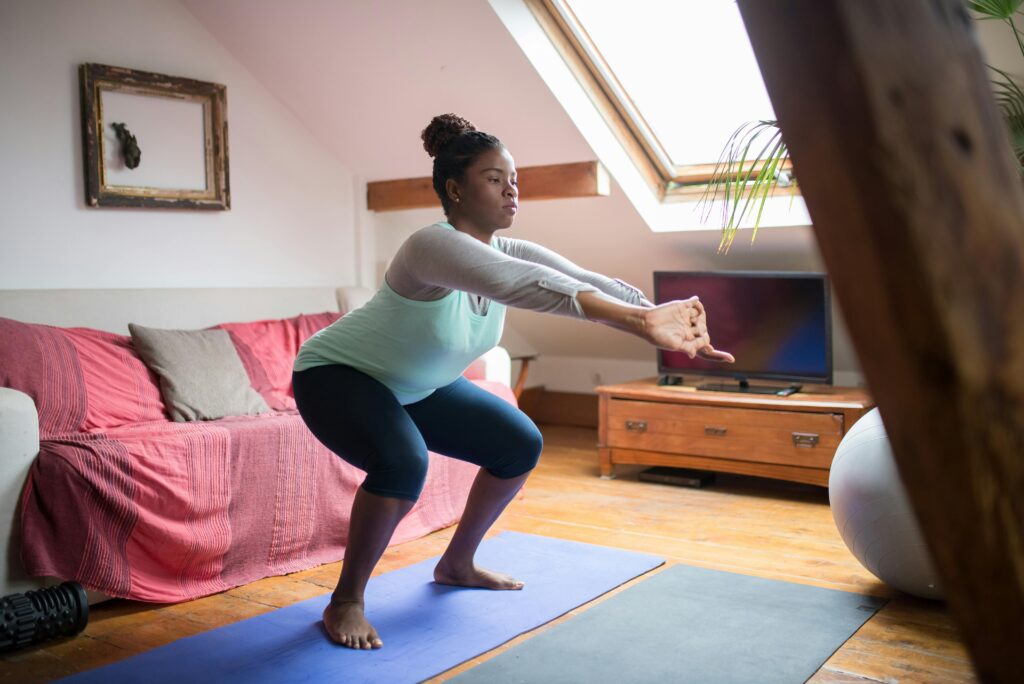
Your own bodyweight is a legitimate training tool. Squats, lunges, push-ups, glute bridges, and planks all challenge your muscles meaningfully without a single piece of equipment. For beginners, who are starting from a lower baseline of strength and fitness, bodyweight exercises are genuinely sufficient for months. The resistance your body provides is more than enough to start building strength, improving cardiovascular fitness, and supporting weight loss.
Gym intimidation is real, and home removes it
Feeling self-conscious in the gym is not a personality flaw, it’s a very common experience, particularly for women who are new to exercise. Working out at home means you can focus entirely on learning the movements and building confidence without any of that noise. Many women who now train happily in a gym started at home precisely because it gave them the space to figure things out without an audience.
Before you start: three things to sort first
Home workouts don’t require much setup, but a few small things make a real difference to how comfortable and consistent your sessions will be.
How much space do you actually need?
About the size of a yoga mat, roughly 180 cm x 60 cm. That’s it. A small section of your lounge room, a cleared bedroom floor, or even a covered balcony is genuinely enough to do a full, effective workout. You don’t need a dedicated home gym or even particularly high ceilings.
What to wear
Comfortable clothing you can move freely in and a pair of supportive shoes — or bare feet if you’re doing yoga or low-impact floor work. That’s all. You don’t need to buy specific workout clothes to get started. Whatever you’d wear for a walk is absolutely fine.
When to work out
The best time to work out is whenever actually fits into your day. Morning workouts are not superior to evening workouts, that’s a persistent myth. What matters is that the time you choose is realistic enough that you’ll actually do it most days. If you’re a night owl and scheduling a 6 am session, it won’t last. Find the slot that has the least competition from other commitments and start there.
The four types of home workout every beginner should know about
Not all workouts are created equal, and different types of exercise do different things for your body. Here’s a plain-language breakdown of what’s available, so you can make an informed choice rather than defaulting to whatever pops up first on YouTube.
1. Bodyweight strength training
Exercises that use your own body as resistance — squats, lunges, push-ups, glute bridges, and planks. This type of training builds lean muscle, which raises your resting metabolic rate and makes fat loss easier and more sustainable over time. It’s the foundation of most effective home workout programmes and requires zero equipment.
Best for: women who want to see body composition change, build functional strength, and support long-term weight loss.
2. Low-impact cardio
Cardiovascular exercise that keeps your heart rate elevated without jumping or high-impact movement — walking, marching in place, step-touches, low-impact dance, and similar. Easy on the joints, appropriate for all fitness levels, and a brilliant entry point for complete beginners or anyone returning to exercise after a break.
Best for: absolute beginners, anyone with knee or joint concerns, and as an active recovery option on lighter days.
3. Yoga and stretching
Often dismissed as ‘not really exercise’, yoga and dedicated stretching work are genuinely valuable for weight loss — not directly through calorie burn, but through stress reduction (which lowers cortisol and reduces stress-related weight gain), improved sleep quality, and better recovery between sessions. They also keep you moving on days when more intense exercise isn’t going to happen.
Best for: women managing high stress or fatigue, anyone dealing with soreness or tightness, and as a complement to strength and cardio work.
4. Beginner HIIT (modified)
Short bursts of effort followed by rest periods — effective for burning calories in a short time window. The key word here is ‘modified’: beginner HIIT should involve no jumping, manageable intensity, and plenty of rest. It’s not the right starting point for complete beginners, but it’s a useful progression once you’ve been training consistently for four to six weeks.
Best for: women with limited time who have already built a baseline of fitness through bodyweight and cardio work.
You don’t need to pick just one type. A well-rounded week mixes two or three.
A complete beginner home workout to try today
Below is a full 30-minute session — warm-up, main workout, and cool-down — that requires no equipment and can be done in the space of a yoga mat. Every exercise includes a modification so you can start wherever you are right now.
WARM-UP — 5 minutes | Do each movement for 45 seconds, no rest between
Exercise | Sets | Reps / Duration | Rest | Beginner modification |
March in place | — | 45 sec | None | Hold a wall for balance if needed |
Arm circles | — | 45 sec | None | Make circles smaller if shoulders feel tight |
Hip rotations | — | 45 sec | None | Keep movement slow and controlled |
Bodyweight squats (slow) | — | 10 reps | None | Lower only as far as feels comfortable |
Torso twists | — | 45 sec | None | Keep hips facing forward, rotate upper body only |
The warm-up matters more than most beginners expect. Cold muscles are injury-prone muscles, and five minutes here will make the whole session feel significantly more comfortable.
MAIN WORKOUT — 20 minutes | 3 rounds | 30 seconds work, 30 seconds rest | 90-second rest between rounds
Exercise | Sets | Reps / Duration | Rest | Beginner modification |
Bodyweight squats | 3 | 30 sec | 30 sec | Hold a chair back for balance |
Glute bridges | 3 | 12 reps | 30 sec | Keep feet flat, press through heels |
Modified push-ups | 3 | 8–12 reps | 30 sec | Knees on floor — fully valid, builds the same muscles |
Reverse lunges | 3 | 8 each leg | 30 sec | Step back instead of forward for more stability |
Standing side crunches | 3 | 12 each side | 30 sec | Slow and controlled — feel the obliques |
Step touches | 3 | 30 sec | 30 sec | Low-impact cardio burst to finish each round |
Rest fully between rounds. 90 seconds feels like a long time when you’re getting started, but your muscles need it. As you get fitter over the following weeks, you can reduce rest to 60 seconds.
COOL-DOWN — 5 minutes | Hold each stretch for 30–45 seconds
Exercise | Sets | Reps / Duration | Rest | Beginner modification |
Standing quad stretch | — | 30–45 sec each | None | Hold a wall if balance is tricky |
Seated hamstring stretch | — | 30–45 sec each | None | Sit on floor, reach toward feet, no bouncing |
Hip flexor stretch | — | 30–45 sec each | None | Kneel on one knee, lean gently forward |
Child’s pose | — | 45 sec | None | Wide knees if hips are tight |
Deep breathing | — | 1 minute | None | In through nose, out through mouth |
The cool-down is where a lot of the recovery benefit happens. Skipping it might save five minutes today, but it’ll make tomorrow’s soreness noticeably worse.
A yoga mat makes floor exercises, stretching, and the cool-down significantly more comfortable — your knees and wrists will thank you. A reliable mat from Amazon typically costs $30–$60 and lasts for years.
How to build a weekly routine that actually sticks
One workout is a great start. A routine is what creates results. Here’s how to think about structuring your week as a beginner.
How many days a week should a beginner exercise?
Three days is the ideal starting point. It’s enough to build a habit and see real progress, but not so much that it feels overwhelming or leads to burnout. Many beginners make the mistake of starting with five or six days a week, burning out in week two, and then quitting entirely. Three consistent days for four weeks beats six chaotic days for ten days every single time.
A simple 3-day starter week
Day | Session | Duration |
Monday | Bodyweight strength workout (the session above) | ~30 min |
Tuesday | Rest or gentle walk | As you feel |
Wednesday | 20-min walk + 10-min full-body stretch | ~30 min |
Thursday | Rest or gentle movement | As you feel |
Friday | Bodyweight strength workout (vary the exercises) | ~30 min |
Saturday | Optional: yoga, walk, or light stretching | 20–30 min |
Sunday | Rest | — |
Rest days are part of the programme
Rest is not laziness — it’s where your muscles actually repair and grow stronger. Progress happens during recovery, not during the workout itself. Rest days are as important as training days, especially in the first few weeks when your body is adapting to a new stimulus. On rest days, gentle movement like a slow walk is absolutely fine and genuinely helpful.
The two-minute rule for days when you really don’t want to
On days when motivation has disappeared, commit to just two minutes. Put your mat down, do two minutes of movement, and then decide if you want to continue. Almost always, you will. Starting is genuinely the hardest part. This reframes motivation as something you build through action rather than something you need to feel before you act.
The only equipment worth buying as a beginner (and what to skip)
Let’s start with the honest truth: you don’t need to buy anything to start. The bodyweight workout above requires nothing but floor space. That said, a couple of inexpensive items do make a genuine difference once you’re a few weeks in.
Worth it — resistance bands
The single best first purchase for home workouts. A set of fabric or loop resistance bands ($15–$35 on Amazon) adds meaningful resistance to squats, glute bridges, and lateral movements, making exercises more effective without adding weight or bulk. They’re lightweight, store in a drawer, and travel easily. Most women get genuinely good use from a set for 12–18 months before wanting anything more.
Worth it — a yoga mat
Floor exercises, stretching, and cool-downs are all significantly more comfortable on a mat than on carpet or a hard floor. A decent mat from Amazon costs $30–$60 and will last for years. Not essential in week one, but worth picking up once you’re three or four sessions in and know you’re going to stick with it.
Worth it eventually — a foam roller
A foam roller ($20–$45) is genuinely useful for recovery — rolling out sore muscles after sessions, reducing next-day stiffness, and keeping you consistent when soreness would otherwise get in the way. Not a priority for week one, but worth adding once you’re training regularly.
Skip for now — everything else
Treadmills, weight benches, kettlebell sets, ab rollers, suspension trainers, and spin bikes are all expensive, space-hungry, and completely unnecessary for a beginner. Save the money. You can build a solid six months of fitness progress with just a mat and a set of resistance bands.
Common beginner workout mistakes (and how to avoid them)
Most people who quit home workouts in the first month do so for predictable reasons. Here’s what to watch out for.
Doing too much too soon
Starting with five or six sessions in week one almost always leads to burnout or injury by week two. Your body needs time to adapt, and enthusiasm at the beginning often outpaces what your muscles, joints, and recovery capacity can actually handle. Start with three sessions. You can always add more later.
Skipping the warm-up
Five minutes feels like time you don’t have, but cold muscles fatigue faster, perform worse, and are significantly more injury-prone than warmed-up ones. The warm-up in the session above takes five minutes. It’s not optional.
Only doing cardio and ignoring strength
Cardio burns calories during the session. Strength training raises your resting metabolic rate for hours afterwards, which means your body burns more calories even while you’re sitting at your desk or sleeping. Both matter — and beginners who only do cardio often plateau quickly and feel like ‘nothing is working’ when the missing variable is simply strength training.
Expecting to feel great in week one
The first two weeks of a new exercise routine often feel harder than expected. Your body is adapting, your muscles are sore in unfamiliar places, and your heart rate will feel higher than it will once you’re fitter. This is completely normal. It’s not a sign that it’s not working — it’s a sign that your body is responding.
Comparing your week one to someone else’s year two
Social media fitness content is highlight reel content. The people posting advanced workouts have been training for months or years. Your week one looks nothing like their week one did either. Her starting point, her timeline, her wins.
Key Takeaways |
✓ You don’t need a gym, equipment, or experience to start — bodyweight training is genuinely effective for months. ✓ Start with 3 days a week. Consistency beats intensity every time, especially at the beginning. ✓ Mix bodyweight strength, low-impact cardio, and stretching for the best all-round results. ✓ If you’re going to buy one thing, make it a resistance band set — cheap, effective, and endlessly versatile. ✓ The two-minute rule: on hard days, just start. The hardest part of any workout is putting your mat down. |
Where to go from here
The hardest workout you’ll ever do is the first one. After that, it gets easier — not just physically, but mentally too. The confidence that comes from showing up for yourself three times a week, even imperfectly, compounds in ways that go well beyond fitness.
If you want a full four weeks of sessions already mapped out for you — so you don’t have to think about what to do next — grab the free beginner workout plan below.
Want to keep reading? Next up: How to Build a Workout Routine You’ll Actually Stick To — a step-by-step guide to making exercise a habit rather than a chore.