You’ve probably heard it a hundred times: “just eat less and move more.” But what does that actually mean? And why, if it’s so simple, does it feel so impossible?
If you’ve Googled “how to lose weight” lately, you’ve likely been hit with a wall of conflicting advice — keto, intermittent fasting, cutting carbs, counting macros — and walked away more confused than when you started. That’s not your fault. The wellness world makes weight loss sound far more complicated than it needs to be.
Here’s what actually underpins every single approach: a calorie deficit. Not a specific diet. Not a magic supplement. Just a modest, consistent gap between the energy you take in and the energy your body uses.
By the end of this post, you’ll understand exactly what a calorie deficit is, how to figure out yours, and — most importantly — how to create one that fits into your real life without obsessing over numbers or giving up the foods you love.
This post contains affiliate links. If you purchase through my links, I may earn a small commission at no extra cost to you — thank you for supporting SlimStrongSquad!
What is a calorie deficit? (The simple version)
A calorie deficit simply means you’re consuming fewer calories than your body burns in a day. That’s it. When your body needs more energy than it’s getting from food, it turns to its stored energy — body fat — to make up the difference. Over time, this leads to fat loss.
Think of it like a bank account. Calories are deposits; your body’s daily activity is the spending. When you consistently spend a little more than you deposit, your body draws from its savings. In this case, the savings are stored as fat.
What is a calorie, exactly?
A calorie is simply a unit of energy. Every food and drink you consume contains a certain number of calories — energy that your body uses to breathe, think, move, digest food, and basically keep you alive. There’s nothing inherently good or bad about a calorie. It’s just fuel.
What does your body actually do in a deficit?
When you eat slightly less than you burn, your body starts breaking down stored fat to use as fuel. This is exactly the process you’re working towards. It doesn’t happen overnight, but it does happen consistently when the conditions are right.
One important thing to understand: a calorie deficit doesn’t mean starving. A modest deficit of 200–500 calories below what you burn is enough to see real results — no misery required.
How many calories do you actually need? (Your daily burn explained)
Before you can create a deficit, you need a rough idea of how many calories your body burns in a day. This number is different for everyone — there’s no universal answer that applies to all women, and anyone who tells you otherwise is oversimplifying.
The four things that affect how many calories you burn
- Basal metabolic rate (BMR): The calories your body burns at rest, just keeping you alive. This makes up 60–70% of your total burn.
- Your size: Larger bodies generally burn more calories at rest than smaller ones.
- Your age: Metabolism tends to slow gradually with age, though the change is more modest than most people expect.
- Your activity level: Everything from structured exercise to walking to the school run counts here.
The combination of all four factors gives you your Total Daily Energy Expenditure — or your “daily calorie burn.” This is the number you’ll use as your starting point.
How to find your number
You don’t need to calculate this by hand. A free online TDEE calculator will do it for you in about 60 seconds — just search “TDEE calculator” and enter your height, weight, age, and rough activity level. The result is an estimate, not a law. Think of it as your starting point to adjust from.
Real-life example: Sarah is 34, works at a desk, and does light exercise two or three times a week. Her daily calorie burn comes out at around 1,900 calories. To lose weight at a steady pace, she’d aim to eat somewhere between 1,400 and 1,700 calories a day — creating a deficit of 200–500 calories without feeling deprived.
How big should your calorie deficit be?
This is the question every beginner wants answered, and the honest answer is: smaller than you think.
The sweet spot for most beginners is 200–500 calories below your daily burn. This creates a pace of roughly 0.25–0.5 kg of fat loss per week — which sounds slow but adds up to 3–6 kg over three months, sustainably.
The “eat as little as possible” trap
It’s tempting to go big — if a 300-calorie deficit is good, surely a 1,000-calorie deficit is better? Unfortunately, no. A deficit that’s too aggressive tends to backfire in several very predictable ways:
- Energy crashes that make it impossible to stay consistent
- Intense hunger that leads to overeating, often undoing the week’s progress in one sitting
- Loss of muscle mass rather than fat, which slows your metabolism over time
- A miserable experience that makes the whole thing feel unsustainable
You may have heard that 1,200 calories is the minimum for women. Whilst this number does exist in a clinical context, it’s not a target — and for many women it’s actually too low to sustain energy, mood, and long-term compliance. The right deficit is the one you can maintain comfortably most days.
What a 300-calorie deficit actually looks like
Three hundred calories is less than you might think. It could be:
- Skipping one large flat white and having a regular black coffee instead
- Swapping an afternoon biscuit for a piece of fruit and a small handful of nuts
- Having a slightly smaller dinner serving and adding an extra walk to your day
These aren’t dramatic changes. That’s the point.
Three ways to create a calorie deficit (pick what works for you)
There’s no single right way to create a deficit. The best approach is the one you can actually maintain. Here are three that work well for different types of people.
1. Track what you eat (even just for a week)
Calorie tracking gets a bad reputation — and when it tips into obsession, that reputation is deserved. But used as a short-term learning tool, it’s one of the most eye-opening things a beginner can do.
Tracking your food for one to two weeks — without changing anything — gives you a clear picture of where your calories are actually coming from. Most people discover two or three specific habits that are adding up in ways they didn’t expect. From there, small adjustments become obvious.
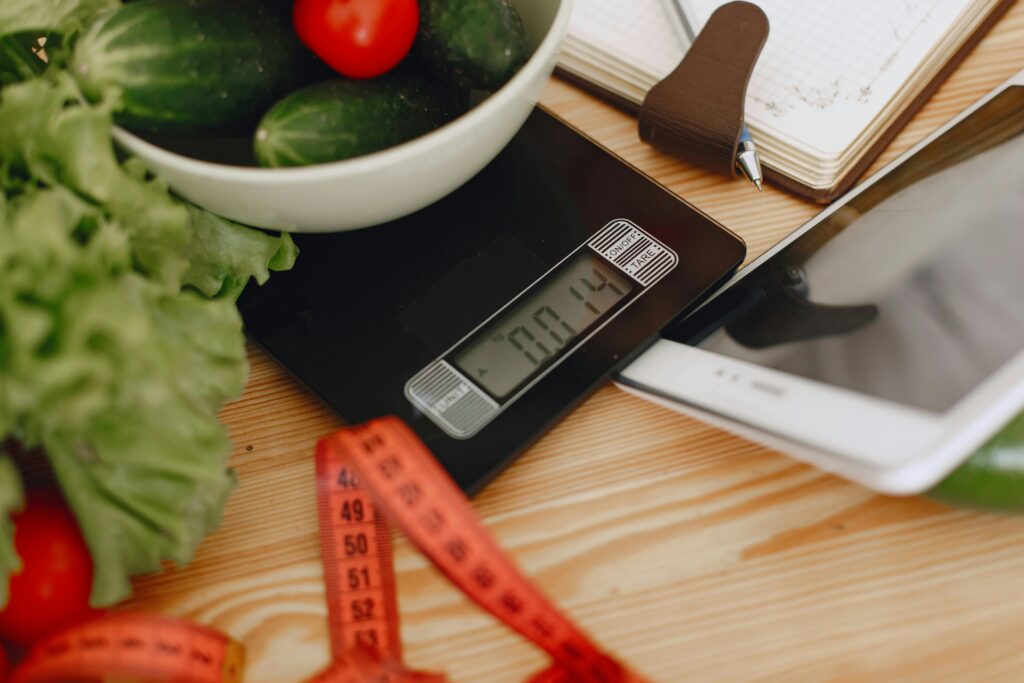
Free apps like MyFitnessPal or Cronometer make this straightforward. A food scale helps you understand what portions actually look like (most people underestimate by 20–30%).
A food scale makes this so much easier. You don’t need anything fancy — this one is under $30, fits on any bench, and will genuinely change how you see portion sizes. Use it for a week or two while you’re getting your bearings, then trust your eye from there.
2. Use the plate method instead
If the idea of tracking calories makes you anxious, the plate method is a brilliant alternative. No app required.
- Half your plate: vegetables and salad
- A quarter of your plate: lean protein (chicken, fish, eggs, legumes, tofu)
- A quarter of your plate: complex carbohydrates (rice, potato, pasta, bread)
- A small amount of healthy fats (olive oil, avocado, cheese)
This naturally reduces calories without counting a single one — because filling half your plate with veg is very filling and very low in calories. Simple and sustainable.
3. Make a few simple swaps
For the absolute beginner, even one or two small changes per week can start creating a meaningful deficit. Some of the easiest:
- Swap sugary drinks (soft drinks, juice, flavoured coffees) for water or herbal tea
- Add protein to breakfast — eggs, Greek yoghurt, or a protein shake — which keeps you fuller for longer and reduces snacking
- Swap one takeaway meal per week for a home-cooked version
- Eat from a smaller plate, which naturally reduces serving sizes without feeling restrictive
None of these require you to eliminate any food group. They work because small changes, compounded over weeks and months, add up to significant results.
Common calorie deficit mistakes (and how to avoid them)
Knowing what a calorie deficit is doesn’t automatically mean it works the way you expect. Here are the most common reasons beginners find themselves in a deficit on paper but not seeing results in practice.
Underestimating portion sizes
This is by far the most common reason women think they’re eating at a deficit when they aren’t. Research consistently shows that people underestimate their calorie intake by 20–30% — and home-cooked meals are particularly tricky because it’s easy to pour a generous serving and call it “one portion.”
Spending a week using a food scale on your most frequent meals will genuinely change your perspective — not to make you paranoid about food, but to give you an accurate baseline.
You can find a more indepth discussion to portion control in my bog “Understanding Portion Control for Weight Loss: How Portion Sizes Really Affect Your Results.”
Eating back all of your exercise calories
Exercise calorie estimates — whether from a fitness watch, a treadmill display, or a tracking app — are notoriously inaccurate and almost always overestimate how much you’ve burned. Eating back the full amount often wipes out your deficit entirely. A useful guideline: eat back no more than half the calories your tracker estimates.
Setting the deficit too aggressive
A 1,000-calorie deficit might show impressive results on a spreadsheet. In real life, it usually leads to intense hunger, energy crashes, and a binge that undoes several days’ progress. Aim for 200–500 calories below your daily burn. Slow and steady genuinely does win this particular race. Find out more on how to Set Realistic Weight Loss Goals That Actually Work.
Being consistent on weekdays but not weekends
This pattern trips up more beginners than almost anything else. Monday through Friday goes well — then Friday night, Saturday, and Sunday add up to significantly more than expected. A deficit of 400 calories per day across five days can easily be erased by two high-calorie weekend days. You don’t need to eat the same way on weekends as you do during the week, but being aware of the pattern helps you manage it.
Not eating enough protein
Protein is your best friend in a calorie deficit. It keeps you fuller for longer, helps preserve muscle mass while you’re losing fat, and requires more energy to digest than carbohydrates or fat. Aim for roughly 1.2–1.6 grams of protein per kilogram of body weight. A 70 kg woman would aim for 84–112 grams per day.
How long until you see results?
This is the question nobody wants to hear the honest answer to — but here it is anyway: probably not as fast as you’d like, and that’s completely fine.
The first one to two weeks
A lot of what you’ll see on the scale in the first week or two isn’t fat loss — it’s water weight. When you reduce carbohydrates or eat less processed food, your body releases stored glycogen (your carbohydrate stores), and glycogen holds a significant amount of water. Some people lose 1–2 kg in the first week and almost none in the second. Both are normal.
What to expect after week two
On a sustainable 300–500 calorie deficit, expect to lose roughly 0.25–0.5 kg per week. Over eight weeks, that’s 2–4 kg of actual fat. Over six months, that’s 6–12 kg — which represents a meaningful, lasting change in how you feel and how your clothes fit.
The scale will fluctuate from day to day. This is normal and has nothing to do with whether you’re making progress. Hormones, hydration, salt intake, and the sheer volume of food in your digestive system all affect the number on any given morning. Weigh yourself at the same time each day (or once a week) and look at the trend over four weeks, not yesterday versus today.
Signs of progress beyond the scale
- Clothes fitting differently, even before the scale moves
- Improved energy levels throughout the day
- Better sleep quality
- Reduced bloating
- Feeling stronger in workouts
Key Takeaways |
✓ A calorie deficit means eating slightly less than your body burns each day — your body makes up the difference by burning stored fat.✓ Find your daily calorie burn using a free TDEE calculator, then subtract 200–500 calories for a sustainable deficit.✓ You don’t have to track every calorie — the plate method and simple food swaps work just as well for many people.✓ Expect 0.25–0.5 kg per week on a sustainable deficit. Slow is normal, healthy, and far more likely to stick.✓ Protein is your best friend in a deficit — it keeps you full, protects muscle, and makes the whole process easier. |
Where to go from here
A calorie deficit is the foundation of weight loss — but understanding it is just the first step. The real work is figuring out how to apply it to your actual life, with your actual schedule, your actual food preferences, and your actual energy levels. That’s what the rest of this blog is here to help you with.
If you’re ready to take the next step, grab my free 7-day beginner meal plan below. It’s already built around a gentle 300–400 calorie deficit, with simple meals that take under 30 minutes — so you don’t have to figure out the numbers yourself.