You’ve been meaning to start working out. You really have. But every time you look into it, the same roadblocks pop up: gym memberships that cost a small fortune, home gym equipment that costs even more, and workout programmes that assume you already know what you’re doing.
Here’s the truth: you don’t need any of that to get started. A set of resistance bands — the kind that fits in a drawer and costs less than a takeaway dinner — is genuinely enough to build strength, support weight loss, and feel fitter than you have in years.
In this post, you’ll learn exactly why resistance bands work (backed by real evidence), what to buy, how to set up your home gym in any space, and a full beginner workout plan to follow for your first four weeks. No guesswork, no overwhelm — just a simple starting point.
This post contains affiliate links. If you purchase through my links, I may earn a small commission at no extra cost to you — thank you for supporting SlimStrongSquad!
Why Resistance Bands Are Enough to Get Started
Let’s address the elephant in the room straight away: are resistance bands actually effective, or are they just for warming up and stretching?
The short answer is — they absolutely work. Research consistently shows that resistance band training produces similar strength and muscle gains to free weight training for beginners. A review published in the Journal of Human Kinetics found that elastic resistance training was just as effective as conventional weight training for improving strength across major muscle groups. When you’re starting from scratch, bands provide more than enough challenge to create the progressive overload your body needs to adapt and get stronger.
But beyond effectiveness, there are a few other reasons bands are the perfect first step for women who are new to strength training:
- They’re joint-friendly. Bands create resistance through a range of motion, which tends to put less strain on your joints than heavy free weights. If you’ve got niggly knees, a sore lower back, or you’re simply cautious about injury — bands are a smart starting point.
- They’re beginner-safe. There’s no risk of dropping a heavy weight or getting stuck under a bar. You can adjust the difficulty instantly by simply choosing a lighter or heavier band.
- They work your whole body. Squats, presses, rows, deadlifts, curls — every major movement pattern can be done with a resistance band. You’re not sacrificing variety by skipping dumbbells.
- They’re inexpensive and portable. A quality set of loop bands costs between $15 and $40. That’s it. No ongoing fees, no monthly membership, no delivery charge for a 50-kilogram barbell set.
Resistance Bands vs Dumbbells — Which Is Better for Beginners?
This is one of the most common questions we hear, so let’s settle it properly.
Both are genuinely effective tools. Dumbbells offer more precise load progression (you can increase by 1 kilogram at a time), and they eventually become necessary once you get stronger and need heavier resistance than bands can provide. But for a beginner? Bands win on almost every practical measure.
- Cost: A full dumbbell set runs $100–$400. A band set costs $15–$40.
- Space: Bands store in a small bag. Dumbbells need a rack.
- Convenience: You can use bands anywhere — your lounge room, backyard, or on holiday.
- Safety: There’s no risk of dropping bands or using improper form that leads to injury.
Our recommendation: start with bands for your first 2–3 months. Once you’ve built a consistent habit, you can decide whether to add a light set of dumbbells. Many women find they stick with bands long-term because they’re so convenient.
Exactly What You Need to Buy (and What to Skip)
One of the most overwhelming parts of starting out is figuring out what to actually purchase. There are hundreds of options online, in every shape, weight, and price range. Here’s how to cut through the noise.
The Only Kit You Actually Need
For a complete beginner home gym, you need just two things:
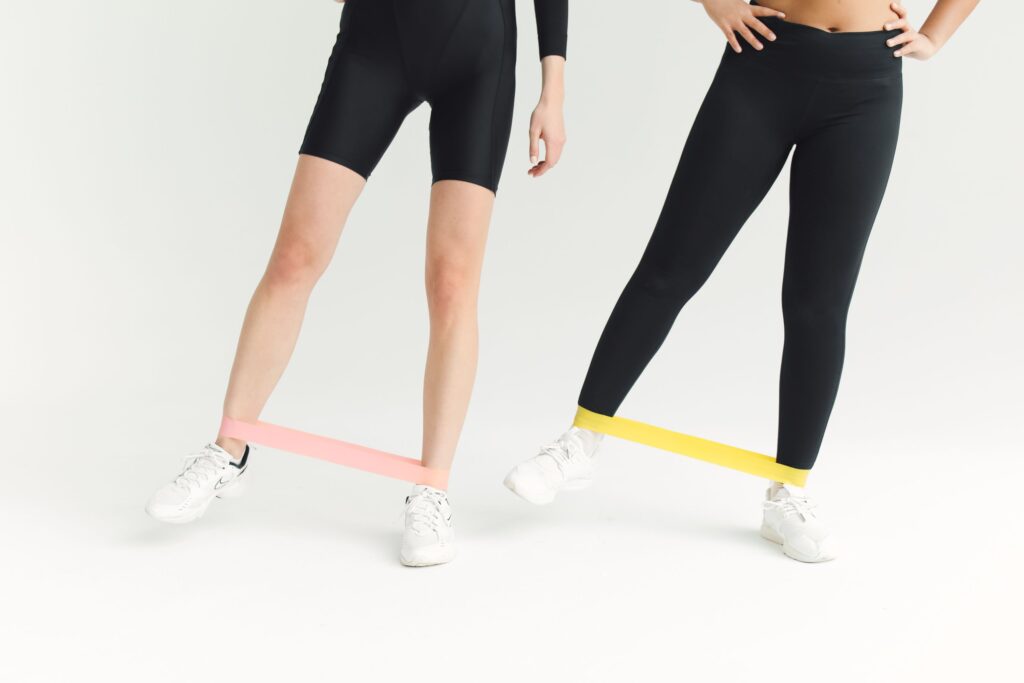
- A loop resistance band set (3–5 levels) — These are the flat, circular bands (also called mini bands or booty bands). A set usually includes light, medium, and heavy resistance options. This covers every exercise in your beginner programme.
- A long resistance band with a door anchor (optional but useful) — A longer band lets you do pulling exercises like rows and lat pulldowns by anchoring it to a door. This opens up a lot more upper body options. If you’re on a tight budget, skip this for now and focus on loop band exercises only.
That’s it. You do not need a mat (though one’s nice to have), you don’t need special shoes, and you don’t need a workout bench. A clear space on your floor and two square metres of room is genuinely all you need.
🛒 AFFILIATE PICK
Our pick: A 5-level loop resistance band set from Amazon — typically $10–$30 , comes with a carry bag, and covers everything in this workout plan.
→ Search ‘resistance band set women’ on Amazon to find current options with strong reviews.
(Prices and availability may vary. We earn a small commission on purchases made through our affiliate link.)
What You Don’t Need
Here’s the list of things you can safely ignore as a beginner:
- A full dumbbell rack — unnecessary for at least your first 2–3 months
- A bench or squat rack — all exercises in this plan are floor or standing-based
- A gym membership — your living room works perfectly
- A foam roller, massage gun, or any recovery gadget — nice extras, not essentials
- Resistance band handles and bars — add complexity without adding results at the beginner stage
Buy the bands. Start the workout. Everything else can wait until you know what you actually enjoy.
How to Set Up Your Resistance Band Home Gym
If the phrase ‘home gym’ conjures images of a dedicated room with rubber flooring and mirrors — relax. Your resistance band home gym takes about 30 seconds to set up and packs away just as fast.
Space Requirements
You need enough room to:
- Stand with your arms extended to the sides (about 1.5–2 metres wide)
- Take a large step forward and back (about 1.5 metres of depth)
- Lie flat on the floor for floor-based exercises
That’s approximately the space of a yoga mat. A bedroom, lounge room, or backyard works perfectly. Apartments are absolutely fine.
Anchoring Your Bands
For most loop band exercises, you’re stepping on the band or wrapping it around your legs — no anchor point needed. For long band exercises like rows:
- A door anchor (usually included with long band kits) loops through a closed door — quick and safe
- A sturdy table leg or pole works for low-anchor exercises
- Your own body can anchor bands for many pulling movements — loop around your feet when sitting
Checking Your Bands Before Each Session
This takes ten seconds and matters for safety. Before you start, give each band a quick once-over:
- Look for any small nicks, cracks, or thin spots in the material
- If a band looks worn or snapped at you before — retire it and replace it
Quality bands last 12–18 months with regular use. A $25 set used three times a week is under $2 a week. It’s excellent value, and replacing a worn band costs a fraction of a physio bill.
Beginner Resistance Band Workout Plan (Weeks 1–4)
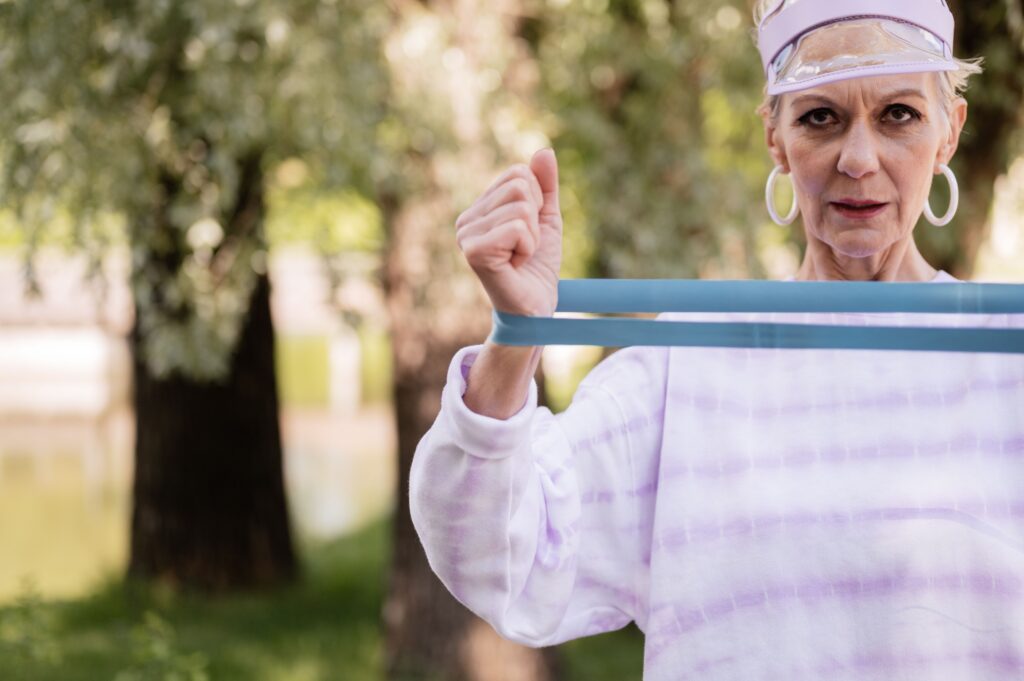
This is a full-body plan designed for complete beginners. You’ll train three times a week on non-consecutive days — for example, Monday, Wednesday, and Friday, or Tuesday, Thursday, and Saturday. Every session works your entire body, which is the most effective approach for beginners who want to build strength and support weight loss at the same time.
Session length: Approximately 30 minutes, including warm-up.
Equipment needed: Loop resistance band set (light, medium, and heavy).
Warm-up: 5 minutes of light movement before you start — walk on the spot, gentle leg swings, arm circles, and a few bodyweight squats with no band.
YOUR WEEKLY WORKOUT
|
Exercise |
Sets |
Reps / Time |
Rest |
Band Level |
Modification |
|
Resistance Band Squat |
3 |
12–15 |
45 sec |
Light–Medium |
Squat to a chair for support |
|
Banded Glute Bridge |
3 |
15 |
30 sec |
Light |
Keep feet flat, squeeze at the top |
|
Standing Band Row |
3 |
12 |
45 sec |
Medium |
Anchor at waist height; pull elbows back |
|
Overhead Press |
3 |
10–12 |
45 sec |
Light |
Press straight up; don’t arch your lower back |
|
Banded Romanian Deadlift |
3 |
12 |
60 sec |
Medium |
Hinge at hips, soft knees; feel the hamstring stretch |
|
Bicep Curl |
2 |
12–15 |
30 sec |
Light |
Step on the band; curl slowly |
|
Tricep Kickback |
2 |
12 |
30 sec |
Light |
Keep upper arm still; only the forearm moves |
|
Pallof Press (Core) |
2 |
10 each side |
30 sec |
Light |
Anchor at chest height; resist rotation |
How to Use the Table
Each exercise is listed with recommended sets, reps (or time), rest, band level, and a modification if you’re finding something too hard. Start on the lighter band for every exercise in Week 1 — getting the movement right matters far more than the resistance level.
If an exercise feels too easy by the end of a set, you’re ready for the next band level. If you can’t complete the reps with good form, drop down. There’s no ego in choosing the right resistance — that’s just smart training.
How to Progress Once It Feels Easy
Progression is what makes training work — your body adapts to a challenge, so you need to keep giving it a slightly bigger one. Here’s a simple ladder to follow:
- Increase your reps — if you’re doing 12, aim for 15 before moving up.
- Increase your band resistance — move from light to medium, then medium to heavy.
- Add a set — go from 2 sets to 3, or 3 to 4.
- Reduce rest time — shorten rest intervals by 10–15 seconds once the current rest feels comfortable.
Progress slowly and consistently. Women who make small, steady improvements week on week get far better long-term results than those who push hard for two weeks and then burn out.
Your Resistance Band Questions Answered
Can resistance bands really build muscle?
Yes — for beginners, absolutely. When you’re new to strength training, your muscles respond to almost any form of progressive resistance. Research shows that beginners can build meaningful strength and muscle with resistance bands, provided they’re challenging themselves consistently and progressing over time. As you advance beyond the beginner stage (typically 3–6 months in), you may want to add dumbbells or other equipment to continue progressing. But for now? Bands are more than enough.
How many bands do I need to start?
A set of three — light, medium, and heavy — covers everything in this workout plan and gives you room to progress. Don’t feel pressure to buy a larger set straight away. Start with three levels and buy more only when you’ve outgrown them.
Can I lose weight with resistance band workouts?
Resistance training plays a meaningful role in weight loss — it builds muscle, which increases your resting metabolic rate (meaning you burn more calories even at rest). Bands are a great tool for this. That said, exercise is just one piece of the puzzle. Nutrition, sleep, stress management, and consistency all matter too. If you want to understand how these pieces fit together, check out our post on creating a calorie deficit the sustainable way.
Are resistance bands safe if I have bad knees or joint pain?
Resistance bands are generally gentler on the joints than free weights, which makes them a popular choice for people with existing niggles. That said, if you have a specific injury or chronic condition, it’s always worth checking in with a physiotherapist or GP before starting a new training programme. They can advise on which movements are safe and which to modify or avoid.
How long until I see results?
Most women notice improved energy and feeling stronger within two to three weeks of consistent training. Visible changes in your body — increased muscle tone, improved posture — typically become noticeable around the four to eight week mark. The key word is
consistent. Three sessions a week, every week, will do more than six sessions one week and none the next. Show up, even when motivation is low, and the results will follow.
✨ KEY TAKEAWAYS
- Resistance bands are scientifically proven to build strength and muscle for beginners — they’re not just for warming up.
- All you need to start is a 3–5 level loop band set, available on Amazon AU for $15–$40.
- Your home gym needs no more than 2 square metres of space — an apartment lounge room is perfect.
- The full-body workout plan in this post (3 sessions per week, 30 minutes each) gives you everything you need for your first four weeks.
- Progress by increasing reps first, then band resistance, then adding sets — slow and steady wins the consistency game.
- Bands are a joint-friendly, beginner-safe, and budget-friendly starting point — and many women stick with them long-term.